8.4.10

Die Unfähigkeit,zu entscheiden

Manager müssen harte Entscheidungen treffen. Solche Entscheidungen werden verzögert oder an untere Chargen delegiert, um sich aus der Verantwortung zu stehlen.

Softskills für ProjektManager
Rund 90 Sekunden nach dem Abheben bemerkte ich: Da waren Vögel. Sie verdunkelten die gesamte Windschutzscheibe. Grosse Vögel. Zu nahe, um auszuweichen.» So beschrieb Airbus-Captain Sullenberger dem Nachrichtensender CBS im Februar 2009 den Beginn der wohl dramatischsten fünf Minuten seiner Pilotenlaufbahn. Am Ende dieser Odyssee setzte er das Flugzeug sicher auf dem Hudson River auf und rettete damit 154 Menschen das Leben. Angesichts der Tatsache, dass eine Notlandung auf dem Wasser zu den schwierigsten Manövern überhaupt zählt, kann Sullenbergers Tat sowohl menschlich als auch fachlich nicht hoch genug eingeschätzt werden. Geradezu euphorisch wurde er darum danach von allen Seiten gefeiert. Ein neuer amerikanischer Held war geboren und Präsident Barack Obama lud ihn zu seiner Amtseinführung nach Washington ein. Auf dem Höhepunkt der Finanzkrise, als Unsicherheit vorherrschte, weil viele US-Bürger um ihren Job bangten, zeigte Sully etwas, nach dem sich die Amerikaner, aber auch wir Schweizer sehnen: Die Bereitschaft eines Vorgesetzten, Verantwortung zu übernehmen und in Krisensituationen die richtigen Entscheidungen zu treffen.

Source: http://www.swissitmagazine.ch/services/ict-aus-weiterbildung/articles/257214/

8.3.10

Checking the entry of a textbox with Regular Expression

If you want to be sure, that the user can just enter a numeric value in a textbox, there is a wise way to check this as following;

private void TextBoxNumericOnly_KeyPress(object sender, KeyPressEventArgs e)
{
if (e.KeyChar != 8)
{
if ((!System.Text.RegularExpressions.Regex.IsMatch(e.KeyChar.ToString(), @"\d+")))
e.Handled = true;
}
}


In the “KeyPress” of textbox the entry is validated with the help of Regular Expression. (e.KeyChar != 8 ensures that backspace is not checked, so that the user can delete his entry with backspace.)

5.3.10

Observer Pattern

The observer pattern (a subset of the publish/subscribe pattern) is a software design pattern in which an object, called the subject, maintains a list of its dependants, called observers, and notifies them automatically of any state changes, usually by calling one of their methods. It is mainly used to implement distributed event handling systems.

image

Pic1. Subject-Observer relationship in Observer Pattern

Observer Pattern

Pic2. UML Diagramm of Observer Pattern


Sources:

1.3.10

Rhetorik und ZABA Methode

Rhetorik ist die Kunst, als Person klar und überzeugend zu sein – also nicht bloss glänzend zu reden. Erfolgreiche Rhetorik ist nicht primär eine Technik, sondern vielmehr eine Haltung mit Selbstvertrauen und Selbstbewusstsein.

Zur Vorbereitung einer Präsentation, bei der es um die Einführung einer neuen Software geht, kann man folgende ZABA-Fragen stellen:

  • Ziel: Was will ich erreichen, was soll die Präsentation bewirken?
  • Anliegen: Worum geht es mir? Was soll für die Gegenseite klar werden? Was muss allenfalls noch geschehen, damit ich erfolgreich bin (Atmosphäre, etc.)
  • Botschaft: Wenn mein Auftritt eine Werbung wäre, wie würde meine Botschaft lauten (ein Satz, der leicht verständlich ist, in Erinnerung bleibt und mir hilft, mein Ziel zu erreichen)?
  • Argumente: Welcher Nutzen entsteht, für wen und in welchem Umfang? welches sind meine zwei bis drei überzeugendsten Argumente (Zahlen, Fakten, Erfahrung, glaubwürdige Erlebnisse, Studien, etc.)? Die beste Argumentationsformel dafür ist “1-2-3”: das überzeugendste Argument zuerst, das zweitbeste am Schluss, alle weiteren dazwischen.

(Quelle: Computerworld.ch Nr. 4/2010, Seite 17, www.thetalkcompany.ch)

1.2.10

Classes vs. Structures in VB.Net

If there are no requirements for polymorphism and events, then structure type is a good candidate instead of a class.

If the container types make use of inheritance and polymorphism, then using class is preferable.

A structure can be preferable when:

  • You have a small amount of data and simply want the equivalent of the UDT (user-defined type) of previous versions of Visual Basic
  • You perform a large number of operations on each instance and would incur performance degradation with heap management
  • You have no need to inherit the structure or to specialize functionality among its instances
  • You do not box and unbox the structure
  • You are passing blittable data across a managed/unmanaged boundary

A class is preferable when:

  • You need to use inheritance and polymorphism
  • You need to initialize one or more members at creation time
  • You need to supply an unparameterized constructor
  • You need unlimited event handling support

Source: Using Classes and Structures in Visual Basic .NET

6.6.09

What Is Analysis and Design? (OOA/D)

Analysis emphasizes an investigation of the problem and requirements, rather than a solution. For example, if a new computerized library information system is desired, how will it be used?

"Analysis" is a broad term, best qualified, as in requirements analysis (an investigation of the requirements) or object analysis (an investigation of the domain objects).

Design emphasizes a conceptual solution that fulfills the requirements, rather than its implementation. For example, a description of a database schema and software objects. Ultimately, designs can be implemented.

As with analysis, the term is best qualified, as in object design or database design.

Analysis and design have been summarized in the phase do the right thing (analysis), and do the thing right (design).

What Is Object-Oriented Analysis and Design?

During object-oriented analysis, there is an emphasis on finding and describing the objects—or concepts—in the problem domain. For example, in the case of the library information system, some of the concepts include Book, Library, and Patron.

During object-oriented design, there is an emphasis on defining software objects and how they collaborate to fulfill the requirements. For example, in the library system, a Book software object may have a title attribute and a getChapter method.

Finally, during implementation or object-oriented programming, design objects
are implemented.

(Source: Larman C., Applying UML & Patterns: Introduction to Object-Oriented
Analysis & Design, & Iterative Development
)

18.12.08

Simple Process Checklist for BPM Workflows

Following questions can serve as a checklist for gathering information about a process;

- What are the individual steps which make up the process?
- Which steps are executed under certain conditions, and which are always executed?
- What Tasks are accomplished at each step?
- Who performs the Tasks at each step?
- What data is to be collected at each step?
- What are the inputs at each step in the process?
- What are the outputs at each step in the process?

(BPM: Business Process Management)

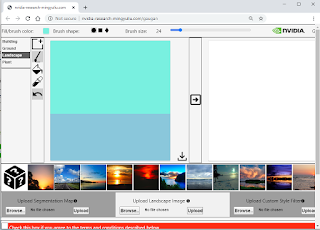
Nvidia's GauGan App

NVIDIA's GauGAN AI Machine Learning Tool creates photorealistic images from Simple Hand Doodling http://nvidia-research-mingyuliu.com/...