- The architecture is forced to match the current organization.
- Top-level architecture components number more than 25.
- One requirement drives the rest of the design.
- The architecture depends upon alternatives in the system software.
- Proprietary components are being used when standard components would do.
- The component definition comes from the hardware division.
- There is redundancy not needed for reliability (or load balancing).
- The design is exception driven (emphasis on the extensibility, not on core commonalities).
- The architect or project manager has difficulty identifying the stakeholders.
- The project team has difficulty identifying the architect(s) of the system.
- Developers have a plethora of choices in how they design and code.
- The architect, when asked for architecture documentation, produces class diagrams and nothing else.
- The architect, when asked for architecture documentation, provides a large stack of automatically generated documents which no humans has ever seen.
- Documents provided are old and apparently not kept up to date.
- A developer, when asked to describe the architecture, is either unable to or describes a much different architecture than the architect presented.
Showing posts with label Architecture. Show all posts
Showing posts with label Architecture. Show all posts
25.6.10
Early warning signs that an SW-Architecture is in trouble

14.6.10
Checklist: questions the architect should plan to answer
- What are the driving architectural constraints, and where are they documented? Are they requirements or goals? Are they measurably quantitative or qualitative? In particular, what are the system's real-time constraints?
- What component types are defined? For each, what are its:
- Responsibilities
- Methods, data members
- Limitations
- Composition rules
- Other characteristics
- What component instances are defined by the architecture?
- How do components communicate and synchronize? In particular:
- Mechanisms used
- Restrictions on use
- What are the system partitions?
- Composition
- Restrictions on use and visibility
- Functional allocations
- What are the styles or architectural approaches used?
- What constitutes the system infrastructure?
- Supplied functionality
- Resource management
- APIs
- Restrictions
- What are the system interfaces? (this includes HMI, devices, external systems)
- Participants
- Mechanisms, formats, protocols, modes
- Identification/typing/versioning What are the strategies and tools used for persistent storage?
- What are the strategies and tools for enforcing security requirements ?
- Trust boundaries
- Threat model
- What are the strategies and tools for handlings faults and failures ?
- What is the process/thread model of the architecture?
- What is the deployment model of the system?
- Server and datastore partitioning/instances
- Topology
- Capacity and sizing
- What are the system states and modes?
- Control
- Responsibilities
- State knowledge dispersal
- What COTS (Commercial off-the-shelf) are used? How are they chosen and integrated?
- What variability (in terms of implementation changes and not data or scenario changes) mechanisms and variation points are included in the architecture ?
- How far along is the development? Were the block delivery dates met? Did the blocks meet their functionality requirements?
- What documentation tree and human help do new employees get?
- What is the skill level and experience of the development team members?
1.2.10
Classes vs. Structures in VB.Net
If there are no requirements for polymorphism and events, then structure type is a good candidate instead of a class.
If the container types make use of inheritance and polymorphism, then using class is preferable.
A structure can be preferable when:
- You have a small amount of data and simply want the equivalent of the UDT (user-defined type) of previous versions of Visual Basic
- You perform a large number of operations on each instance and would incur performance degradation with heap management
- You have no need to inherit the structure or to specialize functionality among its instances
- You do not box and unbox the structure
- You are passing blittable data across a managed/unmanaged boundary
A class is preferable when:
- You need to use inheritance and polymorphism
- You need to initialize one or more members at creation time
- You need to supply an unparameterized constructor
- You need unlimited event handling support
Subscribe to:
Posts (Atom)
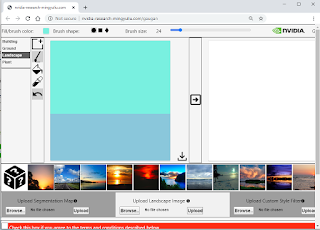
Nvidia's GauGan App
NVIDIA's GauGAN AI Machine Learning Tool creates photorealistic images from Simple Hand Doodling http://nvidia-research-mingyuliu.com/...
-
Code Snippet Index Page (from KTM Wiki) A Access DPI Access an External Database Active Page Index Add a Word Add an Alternative ...
-
 In einem Blog auf ZDNet.com werden die aktuellen technologischen Trends sehr gut dargestellt. http://www.zdnet.com/article/the-enterpri...
-
Windows has with netsh command very useful instruments to enable a laptop or desktop WLAN hotspot to share internet access with tablets, sma...